Table Of Content

The last three lines of the song (“Through the pale door, | A hideous throng rush out forever, | And laugh — but smile no more”) describe the horrible wailing of the person now that their reason has been overthrown. Although the person described in the song isn’t literally Roderick, the description of physical and emotional deterioration evokes his own, showing self-awareness of his pitiful state. And now, some days of bitter grief having elapsed, an observable change came over the features of the mental disorder of my friend. He roamed from chamber to chamber with hurried, unequal, and objectless step. The pallor of his countenance had assumed, if possible, a more ghastly hue—but the luminousness of his eye had utterly gone out. The once occasional huskiness of his tone was heard no more; and a tremulous quaver, as if of extreme terror, habitually characterized his utterance.
The Fall of the House of Usher by Edgar Allan Poe
Its proprietor, Roderick Usher, had been one of my boon companions in boyhood; but many years had elapsed since our last meeting. A letter, however, had lately reached me in a distant part of the country—a letter from him—which, in its wildly importunate nature, had admitted of no other than a personal reply. The writer spoke of acute bodily illness—of a mental disorder which oppressed him—and of an earnest desire to see me, as his best, and indeed his only personal friend, with a view of attempting, by the cheerfulness of my society, some alleviation of his malady. It was the manner in which all this, and much more, was said—it was the apparent heart that went with his request—which allowed me no room for hesitation; and I accordingly obeyed forthwith what I still considered a very singular summons.
Log in or Create account
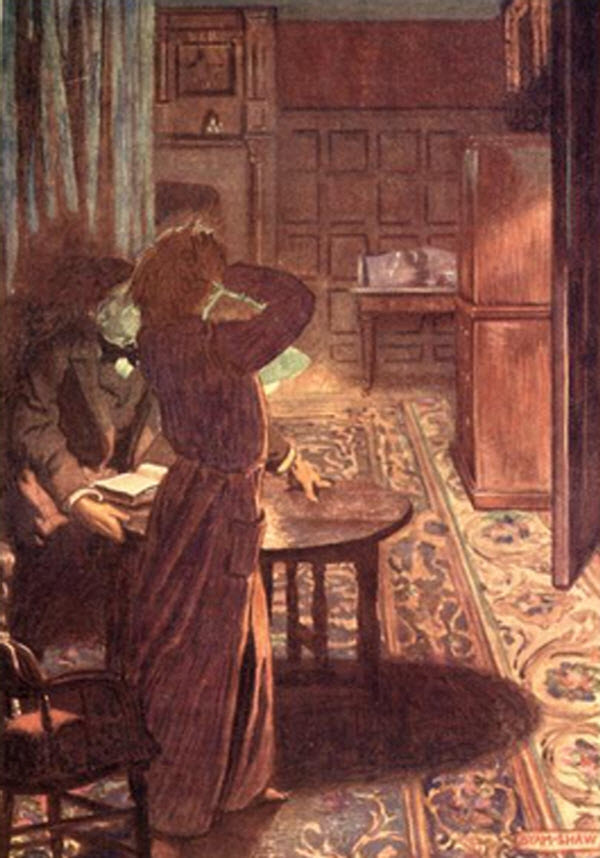
It was thus that he spoke of the object of my visit, of his earnest desire to see me, and of the solace he expected me to afford him. He entered, at some length, into what he conceived to be the nature of his malady. It was, he said, a constitutional and a family evil, and one for which he despaired to find a remedy—a mere nervous affection, he immediately added, which would undoubtedly soon pass off. Some of these, as he detailed them, interested and bewildered me; although, perhaps, the terms, and the general manner of the narration had their weight. I have said that the sole effect of my somewhat childish experiment—that of looking down within the tarn—had been to deepen the first singular impression.
SparkNotes—the stress-free way to a better GPA
The worldly reason, however, assigned for this singular proceeding, was one which I did not feel at liberty to dispute. The brother had been led to his resolution (so he told me) by consideration of the unusual character of the malady of the deceased, of certain obtrusive and eager inquiries on the part of her medical men, and of the remote and exposed situation of the burial-ground of the family. I will not deny that when I called to mind the sinister countenance of the person whom I met upon the staircase, on the day of my arrival at the house, I had no desire to oppose what I regarded as at best but a harmless, and by no means an unnatural, precaution.
Who Is Verna? 'The Fall Of The House Of Usher' Character Explained - Women's Health
Who Is Verna? 'The Fall Of The House Of Usher' Character Explained.
Posted: Thu, 19 Oct 2023 07:00:00 GMT [source]
For a moment she remained trembling and reeling to and fro upon the threshold, then, with a low moaning cry, fell heavily inward upon the person of her brother, and in her violent and now final death-agonies, bore him to the floor a corpse, and a victim to the terrors he had anticipated. Our books—the books which, for years, had formed no small portion of the mental existence of the invalid—were, as might be supposed, in strict keeping with this character of phantasm. One favourite volume was a small octavo edition of the Directorium Inquisitorum, by the Dominican Eymeric de Gironne; and there were passages in Pomponius Mela, about the old African Satyrs and Ægipans, over which Usher would sit dreaming for hours. His chief delight, however, was found in the perusal of an exceedingly rare and curious book in quarto Gothic—the manual of a forgotten church—the Vigilae Mortuorum secundum Chorum Ecclesiae Maguntinae. In the manner of my friend I was at once struck with an incoherence—an inconsistency; and I soon found this to arise from a series of feeble and futile struggles to overcome an habitual trepidancy—an excessive nervous agitation. For something of this nature I had indeed been prepared, no less by his letter, than by reminiscences of certain boyish traits, and by conclusions deduced from his peculiar physical conformation and temperament.
thought on “A Summary and Analysis of Edgar Allan Poe’s ‘The Fall of the House of Usher’”
Some scholars have argued that Madeline does not even exist, reducing her to a shared figment Roderick’s and the narrator’s imaginations. But Madeline proves central to the symmetrical and claustrophobic logic of the tale. Madeline stifles Roderick by preventing him from seeing himself as essentially different from her. DURING THE WHOLE of a dull, dark, and soundless day in the autumn of the year, when the clouds hung oppressively low in the heavens, I had been passing alone, on horseback, through a singularly dreary tract of country; and at length found myself, as the shades of the evening drew on, within view of the melancholy House of Usher. I know not how it was—but, with the first glimpse of the building, a sense of insufferable gloom pervaded my spirit. I say insufferable; for the feeling was unrelieved by any of that half-pleasurable, because poetic, sentiment, with which the mind usually receives even the sternest natural images of the desolate or terrible.

Madeline is buried before she has actually died because her similarity to Roderick is like a coffin that holds her identity. Madeline also suffers from problems typical for women in -nineteenth--century literature. She invests all of her identity in her body, whereas Roderick possesses the powers of intellect. In spite of this disadvantage, Madeline possesses the power in the story, almost superhuman at times, as when she breaks out of her tomb. She thus counteracts Roderick’s weak, nervous, and immobile disposition.
Other Poe Influences In The Fall Of The House Of Usher
It had been used, apparently, in remote feudal times, for the worst purposes of a donjon-keep, and, in later days, as a place of deposit for powder, or some other highly combustible substance, as a portion of its floor, and the whole interior of a long archway through which we reached it, were carefully sheathed with copper. Its immense weight caused an unusually sharp grating sound, as it moved upon its hinges. Upon my entrance, Usher arose from a sofa on which he had been lying at full length, and greeted me with a vivacious warmth which had much in it, I at first thought, of an overdone cordiality—of the constrained effort of the ennuyé man of the world. A glance, however, at his countenance, convinced me of his perfect sincerity. We sat down; and for some moments, while he spoke not, I gazed upon him with a feeling half of pity, half of awe. Surely, man had never before so terribly altered, in so brief a period, as had Roderick Usher!
Madeline attacks her brother and kills both him and herself in the struggle, and the narrator flees the house. It is a stormy night, and as he leaves he sees the house fall down, collapsing into the lake which reflects the house’s image. Roderick Usher is a gifted poet and artist, whose talents the narrator praises before sharing a poem Usher wrote, titled ‘The Haunted Palace’.
This opinion, in its general form, was that of the sentience of all vegetable things. But, in his disordered fancy, the idea had assumed a more daring character, and trespassed, under certain conditions, upon the kingdom of inorganization. I lack words to express the full extent, or the earnest abandon of his persuasion. The belief, however, was connected (as I have previously hinted) with the gray stones of the home of his forefathers. Its evidence—the evidence of the sentience—was to be seen, he said, (and I here started as he spoke,) in the gradual yet certain condensation of an atmosphere of their own about the waters and the walls. The result was discoverable, he added, in that silent, yet importunate and terrible influence which for centuries had moulded the destinies of his family, and which made him what I now saw him—what he was.
All eight episodes were released on Netflix on October 12, 2023, each directed by either Flanagan or Michael Fimognari, with the latter also acting as cinematographer for the entire series. As if in the superhuman energy of his utterance there had been found the potency of a spell—the huge antique panels to which the speaker pointed, threw slowly back, upon the instant, ponderous and ebony jaws. It was the work of the rushing gust—but then without those doors there did stand the lofty and enshrouded figure of the lady Madeline of Usher. There was blood upon her white robes, and the evidence of some bitter struggle upon every portion of her emaciated frame.




No comments:
Post a Comment